

How Often Should a Cadillac Receive Brake Service?
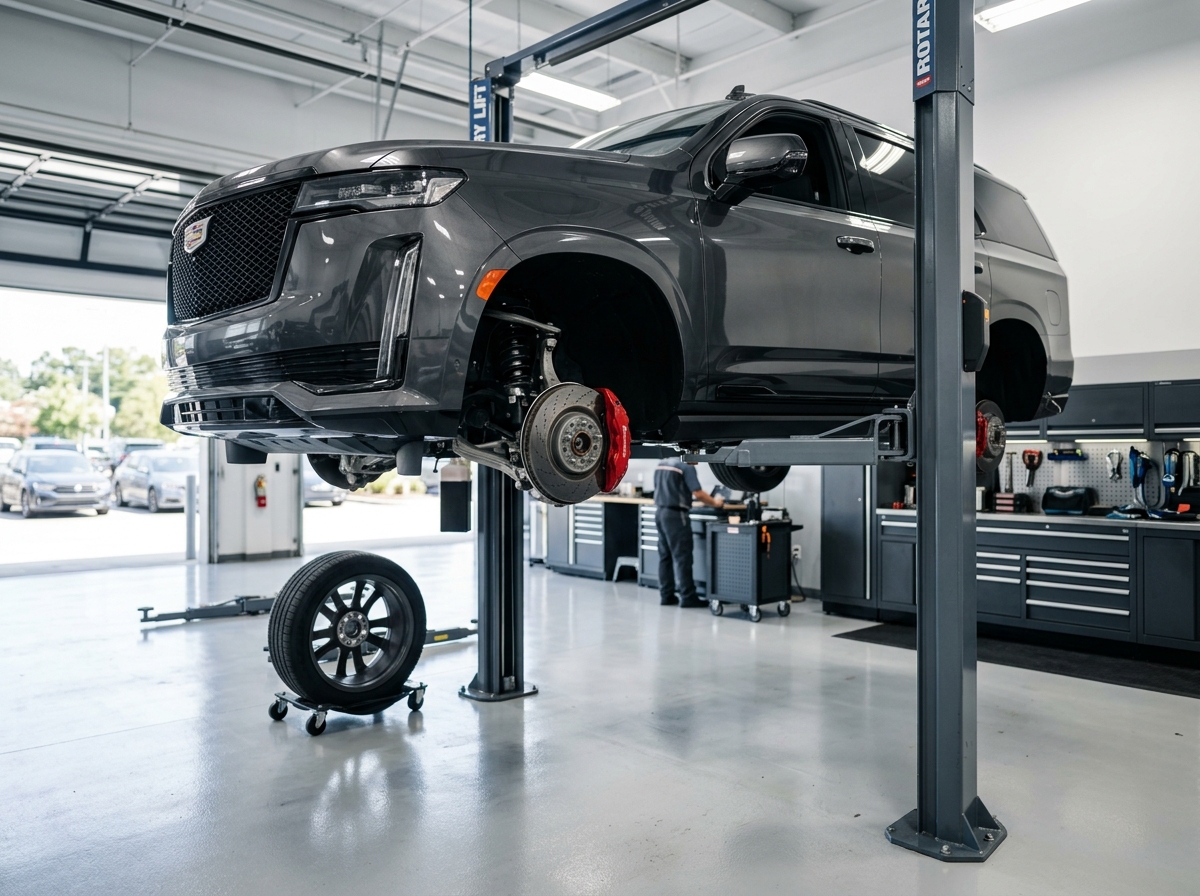
A Cadillac should receive a professional brake inspection every 7,500 to 10,000 miles or at least once per year, typically aligned with routine tire rotations. While physical friction components like brake pads generally last between 30,000 and 70,000 miles depending on vehicle weight and driving environment, routine evaluations allow technicians to monitor pad thickness, rotor condition, and fluid health before stopping performance suffers.
Brake maintenance timing varies across the model lineup due to differences in curb weight, powertrain dynamics, and braking technology. Heavy luxury SUVs such as the Escalade, equipped with a 6.2L V8 engine, place higher kinetic demands on their friction systems during deceleration than smaller crossovers like the XT5 or sports sedans like the CT5. Drivers navigating the stop-and-go arterial corridors and steep limestone hills across Austin often experience accelerated pad wear compared to those traveling on flat, open highways.
Electrified luxury vehicles introduce a different wear profile. Models equipped with regenerative braking systems use the electric drive motor to slow the vehicle, capturing kinetic energy and reducing physical wear on the mechanical brake pads and rotors. However, regular friction brake inspections and fluid maintenance remain necessary because mechanical brakes provide critical stopping force during emergency stops and full halts.
Environmental factors in Central Texas also influence service intervals. Sustained summer heat degrades hydraulic fluid faster, while stop-and-go city traffic keeps brake temperatures elevated. Combining a brake evaluation with every scheduled oil change or tire service ensures your vehicle maintains precise stopping capability. Drivers seeking certified factory care can drop by our dealership location on Research Boulevard or give our service advisors a quick call to verify their recommended maintenance schedule.
Table of Contents
- What Are the Early Warning Signs That Your Cadillac Needs Brake Service?
- Do You Need to Replace Rotors Every Time You Change Cadillac Brake Pads?
- What Is Included in a Cadillac Multi-Point Brake Inspection in Austin?
- Do Cadillac Dealerships Offer Certified Brake Service Coupons and Specials?
- Common Questions About Cadillac Brake Maintenance and Costs
- Schedule Certified Cadillac Brake Repair
What Are the Early Warning Signs That Your Cadillac Needs Brake Service?
Audible squealing or grinding, a spongy brake pedal, steering wheel vibration during deceleration, or an illuminated instrument cluster warning light are the immediate indicator signals that your Cadillac requires a professional brake inspection. Experiencing longer stopping distances or feeling the vehicle pull to one side under braking also signals mechanical unevenness or hydraulic issues that demand swift technical attention.
Catching these warning signals early prevents minor component wear from escalating into high-cost system repairs. High-pitched squealing usually comes from built-in wear indicators touching the rotor face, alerting you that pad friction material has worn down to approximately 2 to 3 millimeters. Ignoring this sound leads to metallic grinding, where the steel backing plate strikes the rotor directly, gouging deep grooves into the metal surface and compromising stopping safety.
Tactile feedback through the pedal and steering column yields valuable diagnostic information:
- A soft or spongy pedal often points to air trapped in the hydraulic lines or moisture-contaminated fluid that compresses under pressure.
- High-frequency pulsing or pedal pulsation during braking indicates rotor surface wear, uneven pad material deposition, or thermal warping.
- Pulling to one side during hard braking suggests a sticking caliper slider pin, a seized hydraulic piston, or uneven hydraulic pressure across axles.
- Extended pedal travel before brake engagement signals severe pad thinness or self-adjusting parking brake mechanism faults.
Luxury vehicles feature advanced electronic wear sensors and integrated vehicle health diagnostics that trigger dashboard alerts well before physical contact damages surrounding hardware. When any of these symptoms appear, scheduling a comprehensive evaluation at our certified Cadillac service center helps protect both system integrity and driver safety.
Do You Need to Replace Rotors Every Time You Change Cadillac Brake Pads?
Replacing rotors with every brake pad change is not mandatory if the current rotors meet factory minimum thickness specifications, exhibit smooth surface parallelism, and show no signs of severe heat scoring, cracking, or warping. Technicians measure rotor thickness with precision micrometers during pad replacement to determine whether resurfacing or full replacement is required.
Modern Cadillac engineering utilizes specialized metallurgy and surface treatments designed to prolong component life. Many factory brake packages feature FNC rotors (Ferritic Nitro-Carburizing), an advanced thermochemical process that hardens the iron surface and creates an iron-nitride protective layer. This treatment dramatically reduces corrosion and rust formation on the rotor face and hat, maintaining a clean surface contact area even after prolonged exposure to humid weather or stationary storage.
Determining whether to resurface or replace a rotor comes down to precise measurements and structural requirements:
- Resurfacing (turning) removes a thin layer of metal to restore a perfectly flat contact face, provided the remaining thickness stays above the cast-in discard specification.
- Replacement is required when the rotor falls below minimum thickness, displays deep heat micro-cracking, or suffers from severe thermal lateral runout.
- High-performance Brembo brake packages, engineered for performance models, often utilize directional, cross-drilled, or slotted rotors that require replacement rather than resurfacing to maintain thermal balance and structural strength.
Installing fresh brake pads onto worn or uneven rotors causes premature pad bedding issues, reduced contact area, and unwanted brake noise. Exploring the specifications across the entire Cadillac lineup reveals how engineered braking systems are matched specifically to each vehicle’s horsepower, weight, and chassis dynamics.
What Is Included in a Cadillac Multi-Point Brake Inspection in Austin?
A comprehensive Cadillac multi-point brake inspection includes a rigorous evaluation of all friction surfaces, hydraulic circuits, mechanical hardware, and electronic safety systems. Factory-trained technicians systematically measure pad thickness, check rotor runout, inspect calipers and flex lines, test fluid moisture content, and scan electronic braking modules for hidden fault codes.
During the inspection process, technicians remove all four wheels to gain clear visual and physical access to every assembly:
- Pad wear measurement: Technicians measure remaining inner and outer friction material using specialized gauges to ensure even wear across the axle.
- Rotor surface inspection: Micrometers record disc thickness while dial indicators measure lateral runout to check for uneven disc thickness or warping.
- Caliper and hardware check: Caliper pistons, dust boots, slider pins, and anti-rattle clips are inspected for smooth movement, fluid leaks, or binding.
- Hydraulic line assessment: Flexible rubber and rigid steel brake lines are checked for cracking, chafing, corrosion, or weeping connections.
- Brake fluid evaluation: Technicians test the fluid’s boiling point and moisture absorption levels using optical refractometers or electronic testers.
Suburban driving demands, such as daily commutes from Round Rock into downtown technology hubs, subject braking systems to repeated thermal cycles and stop-and-go strain. Routine multi-point inspections detect subtle hardware sticking or slight fluid degradation long before it impacts daily driving. Owners of zero-emission vehicles can also review specialized care requirements when exploring our selection of luxury electric vehicles, where regenerative systems operate alongside traditional friction components.
Do Cadillac Dealerships Offer Certified Brake Service Coupons and Specials?
Cadillac dealerships regularly publish certified brake service service offers and maintenance promotions on factory-installed parts. These official specials frequently include offers on GM Genuine Parts brake pad installations, front and rear rotor replacements, complete brake fluid exchanges, and bundled multi-point inspection services.
Leveraging dealership offers allows vehicle owners to maintain their luxury automobile using genuine original equipment parts while managing routine operational costs. Factory brake promotions often combine component rebates with nationwide limited warranty coverage, such as a 24-month/unlimited-mile limited warranty on GM Genuine Parts front brake pads installed by certified technicians.
Common service promotions and specials frequently featured include:
- Front or rear brake pad replacement discounts featuring GM Genuine Parts friction linings.
- Rotor installation packages tailored specifically for luxury crossovers, sedans, and full-size SUVs.
- Brake fluid exchange specials that power-bleed contaminated fluid and replenish the system with fresh GM-approved fluid.
- Special military and community discounts on parts and labor for eligible service work.
- Combined maintenance specials uniting tire rotations, multi-point health checks, and brake assessments into a single visit.
Reviewing current service offers before booking an appointment ensures maximum value for your maintenance investments. Owners can easily access current service offers through our online service and parts specials page, where promotional offers are updated regularly to reflect seasonal maintenance needs.
Common Questions About Cadillac Brake Maintenance and Costs
Q: Why does brake fluid degrade in Cadillac vehicles over time? Brake fluid degrades over time because glycol-based fluids ( DOT 3 and DOT 4) are naturally hygroscopic, meaning they absorb moisture directly from ambient air through micro-pores in rubber hoses and reservoir seals. As water content accumulates inside the sealed hydraulic lines, it significantly lowers the fluid’s boiling point, leading to potential pedal fade under heavy braking. Excess moisture also accelerates internal oxidation, causing corrosion inside caliper pistons, master cylinders, and anti-lock braking system valve blocks. Routine fluid exchanges restore hydraulic pressure response and safeguard precision internal components.
Q: How much does Cadillac brake pad replacement cost on average? Cadillac brake pad replacement typically costs between $150 and $300 per axle for standard models using GM Genuine Parts or ACDelco friction materials, including professional installation and hardware inspection. High-performance V-Series variants or vehicles equipped with specialized Brembo braking hardware require high-friction track-capable pads, placing replacement costs between $300 and $600 per axle. Total costs depend on vehicle trim, axle placement, hardware requirements, and whether related rotor resurfacing or replacement is performed during the same service visit.
Q: Do FNC rotors prevent rust formation on Cadillac vehicles? Yes, FNC rotors significantly reduce rust formation by applying a specialized Ferritic Nitro-Carburizing thermochemical surface treatment to the iron disc. This process diffuses nitrogen and carbon into the top layer of metal, creating an iron-nitride barrier that hardens the rotor face and dramatically increases corrosion resistance. As a result, the rotor hat and outer surfaces resist unsightly orange rust buildup caused by high ambient humidity, rain, or stationary parking, keeping wheels clean and maintaining smooth stopping performance.
Q: Can you schedule a Cadillac brake inspection online with an Austin dealer? Yes, vehicle owners can easily schedule a certified brake inspection online through our interactive service reservation portal in just a few clicks. The digital system allows you to select your vehicle model, specify necessary services—such as a brake noise evaluation, routine inspection, or fluid flush—choose an available date and time, and request convenience amenities like courtesy loaner vehicles or shuttle support. Online scheduling provides immediate appointment confirmation and streamlines your service arrival experience.
Q: What is the difference between Brembo brakes and standard Cadillac brakes? Brembo brake systems feature larger multi-piston fixed calipers, ventilated high-carbon rotors, and high-friction pad compounds engineered for rapid heat dissipation and fade-free stopping power during spirited or high-speed driving. Standard Cadillac braking systems utilize floating single or dual-piston calipers paired with solid or ventilated rotors tuned for quiet operation, low dust, and smooth daily pedal response. While Brembo systems deliver higher thermal capacity, they require specialized maintenance procedures and performance replacement parts.
Schedule Certified Cadillac Brake Repair
Maintaining your vehicle’s braking system with factory-certified care ensures optimal stopping precision, component durability, and total confidence on every drive. Our factory-trained technicians utilize advanced diagnostic tools, specialized equipment, and genuine original equipment parts designed specifically to preserve the engineered performance of your luxury vehicle.
From routine multi-point brake checks and FNC rotor assessments to complete hydraulic fluid exchanges and Brembo pad replacements, our technical team delivers precise workmanship tailored to your vehicle’s exact engineering specifications. Every service includes a comprehensive evaluation of critical safety hardware, protecting your vehicle’s long-term resale value and operational integrity.
Taking proactive care of your vehicle’s maintenance is straightforward and convenient. When you are ready to arrange expert service, visit our conveniently located Austin service center, connect directly with our service desk by giving us a quick call, or order authentic components online through our official GM parts portal today.
© 2026 Covert Cadillac. All rights reserved.

0 comment(s) so far on How Often Should a Cadillac Receive Brake Service?